|
||||||||||||||||||||||||||||||
 |
||||||||||||||||||||||||||||||
|
||||||||||||||||||||||||||||||
|
||||||||||||||||||||||||||||||
 |
||||||||||||||||||||||||||||||
|
||||||||||||||||||||||||||||||
|
||||||||||||||||||||||||||||||
|
||||||||||||||||||||||||||||||
|
||||||||||||||||||||||||||||||
|
||||||||||||||||||||||||||||||
|
||||||||||||||||||||||||||||||
|
||||||||||||||||||||||||||||||
|
||||||||||||||||||||||||||||||
|
||||||||||||||||||||||||||||||

The Coming Prince

|
|
Appendices |

by Sir Robert Anderson,
K.C.B., LL.D.

"THE COMING PRINCE" on 8 html pages-
CHAPTER 1 INTRODUCTORY on page 1 ---New Window
CHAPTERS 2-3 on page 2
---New Window
CHAPTERS 4-6 on page 3
---New Window
CHAPTERS 7-9 on page 4
---New Window
CHAPTERS 10-12 on page 5
---New Window
CHAPTERS 13-15 on page 6
---New Window
PREFACES on page 7
---New Window
APPENDICES on page 8 (this page)
To avoid broken links, due to file length, please wait for the page to
load completely
before selecting ANY link below.
The links above can be used immediately.
Thanks.
Table of Contents
Appendices
.
.
APPENDIX 1.
CHRONOLOGICAL TREATISE AND TABLES
THE point of contact between sacred and profane chronology, and therefore the
first certain date, in biblical history, is the accession of Nebuchadnezzar to the
throne of Babylon (cf. Daniel 1:1 and Jeremiah 25:1). From this date we reckon
on to Christ and back to Adam. The agreement of leading chronologers is a sufficient
guarantee that David began to reign in B.C. l056-5, and therefore that all dates
subsequent to that event can be definitely fixed. But beyond this epoch, certainty
vanishes.. The marginal dates of our English Bible represent: in the main Archbishop
Ussher's chronology, [*]
and notwithstanding his eminence as a chronologer some of these dates are
doubtful, and others entirely wrong.
Of the doubtful dates in Ussher's scheme the reigns of Belshazzar and "Ahasuerus"
may serve as examples. Belshazzar's case is specially interesting. Scripture plainly
states that he was King of Babylon at its conquest by the Medo-Persians, and that
he was slain the night Darius entered the city. On the other hand, not only does
no ancient historian mention Belshazzar, but all agree that the last king of Babylon
was Nabonidus, who was absent from the city when the Persians captured it, and who
afterwards submitted to the conquerors at Borsippa. Thus the contradiction between
history and Scripture appeared to be absolute. Skeptics appealed to history to discredit
the book of Daniel; and commentators solved or shirked the difficulty by rejecting
history. The cuneiform inscriptions, however, have now settled the controversy in
a manner as satisfactory as it was unexpected. On clay cylinders discovered by Sir
H. Rawlinson at Mughier and other Chaldean sites, Belshazzar (Belsaruzur) is named
by Nabonidus as his eldest son. The inference is obvious, that during the latter
years of his father's reign, Belshazzar was King-Regent in Babylon. According to
Ptolemy's canon Nabonidus reigned seventeen years (from s. c. 555 to B.C. 538), and
Ussher gives these years to Belshazzar.
In common with many other writers, Ussher has assumed that the King of the book of
Esther was Darius Hystaspes, but it is now generally agreed that it is the son and
successor of Darius who is there mentioned as Ahasuerus — "a name which orthographically
corresponds with the Greek Xerxes." [1]
The great durbar of the first chapter of Esther, held in his third
year (ver. 3), was presumably with a view to his expedition against Greece (B.C.
483); and the marriage of Esther was in his seventh year (2:16), having been delayed
till then on account of his absence during the campaign. The marginal dates of the
book of Esther should therefore begin with B.C. 486, instead of B.C. 521, as given
in our English Bibles.
But these are comparatively trivial points, whereas the principal error of Ussher's
chronology is of real importance. According to 1 Kings 6:1, Solomon began to build
the Temple "in the 480th year after the children of Israel were come out of
the land of Egypt." The mystic character of this era of 480 years has been noticed
in an earlier chapter. Ussher assumed that it represented a strictly chronological
period, and reckoning back from the third year of Solomon, he fixed the date of the
Exodus as B.C. 1491, — an error which vitiates his entire system.
Acts 13:18-21, St. Paul, in treating of the interval between the Exodus and the end
of Saul's reign, specifies three several periods; viz., 40 years, about 450
years, and 40 years = 530 years. From the accession of David to the third year of
Solomon, when the temple was founded, was forty-three years. According to this enumeration
therefore, the period between the Exodus and the temple was 530 + 43 years = 573
years. Clinton, however, whose chronology has been very generally adopted, conjectures
that there was an interval of twenty-seven years between the death of Moses and the
first servitude, and an interval of twelve years between "Samuel the prophet"
(1 Samuel 7) and the election of Saul. Accordingly he estimates the period between
the Exodus and the temple as 573 + 27 + 12 years = 612 years. [2]
Clinton's leading dates, therefore, are as follows:--
In this chronology Browne proposes three corrections (Ordo Sec., Ch. 10,
13); viz., he rejects the two conjectural terms of twenty-seven years and twelve
years above noticed; and he adds two years to the period between the Deluge and the
Exodus. If this last correction be adopted (and it is perfectly legitimate, considering
that approximate accuracy is all that the ablest chronologer can claim to
have attained for this era), let three years be added to the period between
the Deluge and the Covenant with Abraham, and the latter event becomes exactly, as
it is in any case approximately, the central epoch between the Creation and the Crucifixion.
The date of the Deluge will thus be put back to B.C. 2485, and therefore the Creation
will be B.C. 4141.
The following most striking features appear in the chronology as thus settled:--
The Covenant here mentioned is that recorded in Genesis 12 in connection with
the call of Abraham. The statements of Scripture relating to this part of the chronology
may seem to need explanation in two respects.
Stephen declares in Acts 7:4 that Abraham's removal from Haran (or Charran) took
place after the death of his father. But Abraham was only seventy-five years
of age when he entered Canaan; whereas if we assume from Genesis 11:26 that Abraham
was born when Terah was but seventy, he must have been one hundred and thirty at
the call, for Terah died at two hundred and five. (Compare Genesis 11:26, 31, 32;
12:4.) The fact however is obvious from these statement that though named first among
the sons of Terah, Abraham was not the firstborn, but the youngest: Terah was seventy
when his eldest son was born, and he had three sons, Haran, Nahor, and Abraham. To
ascertain his age at Abraham's birth we must needs turn to the history, and there
we learn it was one hundred and thirty years. [4]
And this will account for the deference Abraham paid to Lot, who, though his
nephew, was nevertheless his equal in years, possibly his senior; and moreover, as
the son of Abraham's eldest brother, the nominal head of the family. (Genesis 13:8,
9.)
Again. According to Exodus 12:40 "the sojourning of the children of Israel,
who dwelt in Egypt, was 430 years." If this be taken to mean (as the statement
in Genesis 15:13, quoted by Stephen in Acts 7:6, might also seem to imply) that the
Israelites were four centuries in Egypt, the entire chronology must be changed. But,
as St. Paul explains in Galatians 3:17, these 430 years are to be computed from the
call of Abraham, and not from the going down of Israel into Egypt. The statement
in Genesis 15:13 is explained and qualified by the words which follow in ver. 16.
The entire period of Israel's wanderings was to be four centuries, but when the passage
speaks definitely of their sojourn in Egypt it says' "In the fourth generation
they shall come hither again" — a word which was accurately fulfilled, for Moses
was the fourth in descent from Jacob. [5]
It was not till 470 years after the covenant with Abraham that his descendants
took their place as one of the nations of the earth. They were slaves in Egypt, and
in the wilderness they were wanderers; but under Joshua they entered the land of
promise and became a nation. And with this last event begins a series of cycles of
"seventy weeks" of years.
Again the period Between the dedication of the first temple in the eleventh year
of Solomon (B.C. 1066-5) and the dedication of the second temple in the sixth year
of Darius Hystaspes of Persia (B.C. 515), was 490 years. [6]
Are we to conclude that these results are purely accidental? No thoughtful
person will hesitate to accept the more reasonable alternative that the chronology
of the world is part of a Divine plan or "economy of times and seasons."
The chronological inquiry suggested by the data afforded by the books of 2 Kings,
2 Chronicles, Jeremiah, Ezekiel, and Daniel, is of principal importance, not only
as establishing the absolute accuracy of Scripture, but also because it throws light
upon the main question of the several eras of the captivity, which again are closely
allied with the era of the seventy weeks.
The student of the book of Daniel finds every step beset with difficulties, raised
either by avowed enemies, or quasi expositors of Holy Writ. Even the opening
statement of the book has been assailed on all sides. That Daniel was made captive
in the third year of Jehoiakim "is simply an invention of late Christian days,"
declares the author of Messiah the Prince (p. 42), in keeping with the style
in which this writer disposes of history sacred and profane, in order to support
his own theories.
In Dean Milman's History of the Jews, the page which treats of this epoch is full
of inaccuracies. First he confounds the seventy years of the desolations, predicted
in Jeremiah 25., with the seventy years of the servitude, which had already begun.
Then as the prophecy of Jeremiah 25: was given in the fourth year of Jehoiakim, he
fixes the first capture of Jerusalem in that year, whereas Scripture expressly states
it took place in Jehoiakim's third year (Daniel 1:1). He proceeds to specify B.C.
601 as the year of Nebuchadnezzar's invasion; and here the confusion is hopeless,
as he mentions two periods of three years each between that date and the king's death,
which nevertheless he rightly assigns to the year B.C. 598.
Again, Dr. F. W. Newman's article on the Captivities, in Kitto's Cyclopaedia,
well deserves notice as a specimen of the kind of criticism to be found in standard
books ostensibly designed to aid the study of Scripture.
This writer's conclusions are adopted by Dean Stanley in his Jewish Church
(vol. 2., p. 459), wherein he enumerates among the captives taken with Jehoiachin
in the eighth year of Nebuchadnezzar, the prophet Daniel, who had gained a position
at the court of Babylon six years before Jehoiachin came to the throne! (Compare
2 Kings 24:12 with Daniel 2:1.)
A reference to the Five Great Monarchies (vol. 3., pp. 488-494), and the Fasti
Hellenici, will show how thoroughly consistent the sacred history of this period
appears to the mind of a historian or a chronologer; and moreover how completely
it harmonizes with the extant fragments of the history of Berosus.
Jehoiakim did in fact reign eleven years. In his third year he became the vassal
of the King of Babylon. For three years he paid tribute, and in his sixth year he
revolted. There is not a shadow of reason for believing that the first verse of Daniel
is spurious; and apart from all claim to Divine sanction for the book, the idea that
such a writer — a man of princely rank and of the highest culture, (Daniel 1:3, 4.)
and raised to the foremost place among the wise and noble of Babylonia — was ignorant
of the date and circumstances of his own exile, is simply preposterous. But according
to Dr. Newman, he needed to refer to the book of Chronicles for the information,
and was deceived thereby! A comparison of the statements in Kings, Chronicles, and
Daniel clearly establishes that the narratives are independent, each giving details
omitted in the other books. The second verse of Daniel appears inconsistent with
the rest only to a mind capable of supposing that the living king of Judah was placed
as an ornament in the temple of Belus along with the holy vessels; for so Dr. Newman
has read it. And the apparent inconsistency in 2 Chronicles 36:6 disappears when
read with the context, for the eighth verse shows the writer's knowledge that Jehoiakim
completed his reign in Jerusalem. Moreover the correctness of the entire history
is signally established by fixing the chronology of the events, a crucial test of
accuracy.
Jerusalem was first taken by the Chaldeans in the third year of Jehoiakim (Daniel
1:1). His fourth year was current with the first of Nebuchadnezzar (Jeremiah 25:1).
This accords with the deft, the statement of Berosus that Nebuchadnezzar's first
expedition took place before his actual accession (Jos., Apion, 1. 19). According
to the canon of Ptolemy, the accuracy of which has been fully established, the reign
of Nebuchadnezzar dates from B.C. 604, i.e., his accession was in the year
beginning the first Thoth (which fell in January) B.C. 604, and the history leaves
no doubt it was early in that year. But the captivity, according to the era of Ezekiel,
began in Nebuchadnezzar's eighth year (comp. Ezekiel 1:2 and 2 Kings 24:12); and
in the thirty-seventh year of the captivity, Nebuchadnezzar's successor was on the
throne (2 Kings 25:27). This would give Nebuchadnezzar a reign of at least: forty-four
years, whereas according to the Canon (and Berosus confirms it) he reigned only forty-three
years, and was succeeded by Evil-Merodach
(the Iluoradam of the Canon), in B.C. 561.
It follows therefore that Scripture antedates the years of Nebuchadnezzar, computing
his reign from B.C. 605. [7]
This would be sufficiently accounted for by the fact that, from the conquest
of Jerusalem in the third year of Jehoiakim, the Jews acknowledged Nebuchadnezzar
as their suzerain. It has been overlooked, however, that it is in accordance with
the ordinary principle on which they reckoned regnal years, computing them from Nisan
to Nisan. In B.C. 604 the 1st Nisan fell on or about the 1st April, [8] and according to Jewish reckoning, the King's second year
would begin on that day, no matter how recently he had ascended the throne. Therefore
"the fourth year of Jehoiakim that was the first year of Nebuchadnezzar"
(Jeremiah 25:1), was the year beginning Nisan B.C. 605; and the third of Jehoiakim,
in which Jerusalem was taken and the servitude began, was the year beginning Nisan
B.C. 606.
This result is most remarkably confirmed by Clinton, who fixes the summer of B.C.
606 as the date of Nebuchadnezzar's first expedition. [9]
It is further confirmed by, and affords the explanation of a statement of
Daniel, which has been triumphantly appealed to in depreciation of the value of his
book. If, it is urged, the King of Babylon kept Daniel three years in training before
admitting him to his presence, how could the prophet have interpreted the King's
dream in his second year? (Daniel 1:5, 18; 2:1). Daniel, a citizen of Babylon, and
a courtier withal, naturally and of course computed his sovereign's reign according
to the common era in use around him (as Nehemiah afterwards did in like circumstances.)
But as the prophet was exiled in B.C. 606, his three years' probation terminated
at the close of B.C. 603, whereas the second year of Nebuchadnezzar, computed from
his actual accession, extended to some date in the early months of B.C. 602.
Again. The epoch of Jehoiachin's
captivity was in the eighth year of Nebuchadnezzar (2 Kings 24:12), i.e.,
his eighth year as reckoned from Nisan.
But the ninth year of the captivity was still current on the tenth Tebeth in the
ninth year of Zedekiah and seventeenth of Nebuchadnezzar (comp. Ezekiel 24:1, 2,
with 2 Kings 25:1-8).
And the nineteenth year of Nebuchadnezzar and
eleventh of Zedekiah, in which Jerusalem was destroyed,
was in part concurrent with the twelfth year of the captivity (comp. 2 Kings 25:2-8
with Ezekiel 33:21).
It follows therefore that Jehoiachin (Jeconiah) must have been taken at the
close of the Jewish year ("when the year was expired," 2 Chronicles
36:10), that is the year preceding 1st Nisan, B.C. 597; and Zedekiah was made king
(after a brief interregnum) early in the year beginning on that day. [10] And it also follows that whether computed according to the
era of Nebuchadnezzar, of Zedekiah, or of the captivity, B.C. 587 was the year in
which "the city was smitten." [11]
The first link in this chain of dates is the third year of Jehoiakim, and
every new link confirms the proof of the correctness and importance of that date.
It has been justly termed the point of contact between sacred and profane history;
and its importance in the sacred chronology is immense on account of its being the
epoch of the servitude of Judah to the King of Babylon.
The servitude must not be confounded with the captivity, as it generally is. It was
rebellion against the Divine decree which entrusted the imperial scepter to Nebuchadnezzar,
that brought on the Jews the further judgment of a national deportation, and the
still more terrible chastisement of the "desolations." The language of
Jeremiah is most definite in this respect. "I have given all these lands into
the hand of Nebuchadnezzar, the king of Babylon, my servant." "The nation
which will not serve the same Nebuchadnezzar, the king of Babylon, that nation will
I punish, saith the Lord, with the sword, and with the famine, and with the pestilence,
until I have consumed them by his hand." But the nations that bring their neck
under the yoke of the king of Babylon, and serve him, those will I let remain
still in their own land, saith the Lord, and they shall till it and dwell therein"
(Jeremiah 27:6, 8 11; and comp. chap.38:17-21).
The appointed era of this servitude was seventy years, and the twenty-ninth chapter
of Jeremiah was a message of hope to the captivity, that at the expiration of that
period they should return to Jerusalem (ver. 10). The twenty-fifth chapter, oil the
oilier hand, was a prediction for the rebellious Jews who remained in Jerusalem after
the servitude had commenced, warning them that their stubborn disobedience would
bring on them utter destruction, and that for seventy years the whole land should
be "a desolation."
To recapitulate. The thirty-seventh year of the captivity was current on the accession
of Evil-Merodach (2 Kings 25:27), and the epoch of that king's reign was B.C. 561.
Therefore the captivity dated from the year beginning Nisan 598 and ending Adar 597.
But this was the eighth year of Nebuchadnezzar according to Scripture reckoning.
Therefore his first year was Nisan 605 to Nisan 604. The first capture of Jerusalem
and the beginning of the servitude was during the preceding year, 606-605. The final
destruction of the city was in Nebuchadnezzar's nineteenth year, i.e., 587,
and the siege began 10th Tebeth (or about 25th December), 589, which was the epoch
of the desolations. The burning of Jerusalem cannot have been B.C. 588, as given
by Ussher, Prideaux, etc., for in that case [12]
the captivity would have begun B.C. 599, and the thirty-seventh year would
have ended before the accession of Evil-Merodach. Nor can it have been B.C. 586,
as given by Jackson, Hales, etc., for then the thirty-seventh year would not have
begun during Evil-Merodach's first year. [13]
This scheme is practically the same as Clinton's, [14] and the sanction of his name may be claimed for it, for it
differs from his only in that he dates Jehoiakim's reign from August B.C.
609, and Zedekiah's from June B.C. 598, his attention not having been called
to the Jewish practice of computing reigns from Nisan; whereas I have fixed
Nisan B.C. 608 as the epoch of Jehoiakim's reign, and Nisan B.C. 597 for Zedekiah's.
Not of course that Nisan was in fact the month-date of the accession, but that, according
to the rule of the Mishna and the practice of the nation, the reign was so
reckoned. Jehoiakim's date could not be Nisan B.C. 609, because his fourth
year was also the first of Nebuchadnezzar, and the thirty-seventh year, reckoned
from the eighth of Nebuchadnezzar, was the first of Evil-Merodach, i.e., B.C.
561, which date fixes the whole chronology as Clinton himself conclusively argues.
[15] It follows from this
also that: Zedekiah's date must be B.C. 597, and not 598.
The chronology adopted by Dr. Pusey [16]
is essentially the same as Clinton's. The scheme here proposed differs from
it only to the extent and on the grounds above indicated. His suggestion: that the
fast proclaimed in the fifth year of Jehoiakim (Jeremiah 36:9.) referred to the capture
of Jerusalem in his third year, is not improbable, and points to Chisleu (Nov.) B.C.
606 as the date of that event. For the reasons above stated, it could not have been
B.C. 607, as Dr. Pusey supposes, and the same argument proves that Canon Rawlinson's
date for Nebuchadnezzar's expedition (B.C. 605) is a year too late. [17]
The correctness of this scheme will, I presume, be admitted, as regards the
cardinal point of difference between it and Clinton's chronology, namely, that the
reigns of the Jewish kings are reckoned from Nisan. It remains to notice the points
of difference between the results here offered and Browne's hypotheses (Orda Saec.,
Ch. 162-169). He arbitrarily assumes that Jehoiachin's captivity and Zedekiah's reign
began on the same day. This leads him to assume further (1) that they were
reckoned from the same day, viz., the 1st Nisan, and (2) that Nebuchadnezzar's
royal years dated from some date between 1st Nisan and 10 Ab 606 (Ch. 166).
Both these positions are untenable. (1) The Jews certainly reckoned the reigns of
their kings from 1st Nisan, but there is no proof that they so reckoned the years
of ordinary periods or eras such as the captivity. (2) The presumption is strong,
confirmed by all the synchronisms of the chronology, that they computed Nebuchadnezzar's
royal era either according to the Chaldean reckoning, as in Daniel, or according
to their own system, as in the other books.
TABLE #1-- CHRONOLOGICAL TABLE
The following table will show at a glance the several eras of the servitude to
Babylon, king Jehoiachin's captivity, and the desolations of Jerusalem.
In using the table it is essential to bear in mind two points already stated.
If these points be kept in view the chronology of the table will be found to harmonize
every chronological statement relating to the period embraced in it, contained
in the Books of Kings, Chronicles, Jeremiah, Ezekiel, and Daniel.
|
|
||||||
|
Jewish Year* |
Kings of Babylon |
Kings of Judah |
Era of the Servitude |
Era of the Captivity |
|
Events and Remarks |
|
B.C. |
20th year of Nabopolassar |
3rd year of Jehoiakim (Eliakim) |
1 |
- |
- |
The 3rd year of Jehoiakim, from 1st Nisan, 606, to 1st Nisan, 605. Jerusalemtaken by Nebuchadnezzar (Dan. i. 1, 2), see p. 231, ante. With this event the servitude to Babylon began, 490 years (or 70 weeks of years) after the establishment of the Kingdom under Saul. "The 4th year of Jehoiakim, that was the 1st year of Nebuchadnezzar," i.e., the year beginning 1st Nisan, 605 (Jer. xxv. 1). |
|
605 |
Nebuchad |
4 |
2 |
- |
- |
|
|
604 |
2 |
5 |
3 |
- |
- |
Vision of the great image (Dan. ii). |
|
603 |
3 |
6 |
4 |
- |
- |
- |
|
602 |
4 |
7 |
5 |
- |
- |
- |
|
601 |
5 |
8 |
6 |
- |
- |
- |
|
600 |
6 |
9 |
7 |
- |
- |
- |
|
599 |
7 |
10 |
8 |
- |
- |
- |
|
598 |
8 |
11 |
9 |
1 |
- |
This year included the 3 months' reign of Jehoiachin (Jeconiah), whose captivity began in the 8th year of Nebuchadnezzar (2 Kings xxiv. 12, see pp. 234, 236, ante). |
|
3 months of Jehoiachin |
||||||
|
597 |
9 |
Zedekiah |
10 |
2 |
- |
Reigned 11 years (2 Kings xxiv. 18). |
|
596 |
10 |
2 |
11 |
3 |
- |
- |
|
595 |
11 |
3 |
12 |
4 |
- |
- |
|
594 |
12 |
4 |
13 |
5 |
- |
Ezekiel began to prophesy in the 30th year from Josiah's Passover (2 Kings xxiii. 23), and the 5th year of the captivity (Ezek. i. 1,2.) |
|
593 |
13 |
5 |
14 |
6 |
- |
- |
|
592 |
14 |
6 |
15 |
7 |
- |
- |
|
591 |
15 |
7 |
16 |
8 |
- |
- |
|
590 |
16 |
8 |
17 |
9 |
- |
- |
|
589 |
17 |
9 |
18 |
10 |
1 |
Jerusalem invested for the third time by Nebuchadnezzar, on the 10th day of Tebeth-- "the fast of Tebeth,"-- the epoch of the "Desolations" (see pp. 69, 70, ante). |
|
588 |
18 |
10 |
19 |
11 |
2 |
"The 10th year of Zedekiah, which was the 18th year of Nebuchadnezzar" (Jer. xxxii. 1). |
|
587 |
19 |
11 |
20 |
12 |
3 |
Jerusalem taken on the 9th day of the 4th month, and burnt on the 7th day of the 5th month in the 11th year of Zedekiah, and the 19th year of Nebuchadnezzar (2 Kings xxv. 2,3,8,9, see p. 234, ante), called "The 12th year of our Captivity" in Ezek. xxxiii. 21, the news having reached the exiles on the 5th day of the 10th month. |
|
586 |
20 |
- |
21 |
13 |
4 |
- |
|
585 |
21 |
- |
22 |
14 |
5 |
- |
|
584 |
22 |
- |
23 |
15 |
6 |
- |
|
583 |
23 |
- |
24 |
16 |
7 |
- |
|
582 |
24 |
- |
25 |
17 |
8 |
- |
|
581 |
25 |
- |
26 |
18 |
9 |
- |
|
580 |
26 |
- |
27 |
19 |
10 |
- |
|
579 |
27 |
28 |
20 |
11 |
- |
- |
|
578 |
28 |
29 |
21 |
12 |
- |
- |
|
577 |
29 |
30 |
22 |
13 |
- |
- |
|
576 |
30 |
31 |
23 |
14 |
- |
- |
|
575 |
31 |
32 |
24 |
15 |
- |
- |
|
574 |
32 |
33 |
25 |
16 |
- |
The 25th year of the Captivity was the 14th (inclusive, as the Jews usually reckoned) from the destruction of Jerusalem (Ezek. xl. 1). |
|
573 |
33 |
34 |
26 |
17 |
- |
- |
|
572 |
34 |
35 |
27 |
18 |
- |
- |
|
571 |
35 |
36 |
28 |
19 |
- |
- |
|
570 |
36 |
37 |
29 |
20 |
- |
- |
|
569 |
37 |
38 |
30 |
21 |
- |
- |
|
568 |
38 |
39 |
31 |
22 |
- |
- |
|
567 |
39 |
40 |
32 |
23 |
- |
- |
|
566 |
40 |
41 |
33 |
24 |
- |
- |
|
565 |
41 |
42 |
34 |
25 |
- |
- |
|
564 |
42 |
43 |
35 |
26 |
- |
- |
|
563 |
43 |
44 |
36 |
27 |
- |
- |
|
562 |
44 |
45 |
37 |
28 |
- |
According to the Canon, the accession of Iluoradam (Evil-Merodach) was in the year beginning 1st Thoth (11th Jan.) B.C. 561, (see p. 232, ante). But the year 562 in this table is the Jewish year, i.e., the year preceding 1st Nisan (or about 5th April 561, and the 37th year of Jehoiachin's captivity was current till towards the close of that year. In this year Jehoiachin was "brought forth out of prison." (Jer. lii. 31). |
|
561 |
Evil-Merodach |
46 |
38 |
29 |
- |
- |
|
560 |
2 |
47 |
39 |
30 |
- |
- |
|
559 |
Neriglissar or Nergalsherezer |
48 |
40 |
31 |
- |
- |
|
558 |
2 |
- |
49 |
41 |
32 |
- |
|
557 |
3 |
- |
50 |
42 |
33 |
- |
|
556 |
4 |
- |
51 |
43 |
34 |
- |
|
555 |
Nabonidus |
- |
52 |
44 |
35 |
The Nabonadius of the Canon is called Nabunnahit in the Inscriptions, and Labynetus by Herodotus. |
|
554 |
2 |
- |
53 |
45 |
36 |
- |
|
553 |
3 |
- |
54 |
46 |
37 |
- |
|
552 |
4 |
- |
55 |
47 |
38 |
- |
|
551 |
5 |
- |
56 |
48 |
39 |
- |
|
550 |
6 |
- |
57 |
49 |
40 |
- |
|
549 |
7 |
- |
58 |
50 |
41 |
- |
|
548 |
8 |
- |
59 |
51 |
42 |
- |
|
547 |
9 |
- |
60 |
52 |
43 |
- |
|
546 |
10 |
- |
61 |
53 |
44 |
- |
|
545 |
11 |
- |
62 |
54 |
45 |
- |
|
544 |
12 |
- |
63 |
55 |
46 |
- |
|
543 |
13 |
- |
64 |
56 |
47 |
- |
|
542 |
14 |
- |
65 |
57 |
48 |
- |
|
541 |
15 |
- |
66 |
58 |
49 |
In or before this year, Belshazzar (the Belsaruzur of the Inscriptions) became regent in the lifetime of his father, Nabonadius. Daniel's vision of the Four Beasts was in the 1st year, and his vision of the Ram and the Goat was in the 3rd year of Belshazzar (Dan. vii., viii.). |
|
540 |
16 |
- |
67 |
59 |
50 |
- |
|
539 |
17 |
- |
68 |
60 |
51 |
- |
|
538 |
Darius (the Mede) |
- |
69 |
61 |
52 |
Babylon taken by Cyrus. Daniel's vision of the 70 weeks was in this year. |
|
537 |
2 |
- |
70 |
62 |
53 |
- |
|
536 |
Cyrus |
- |
- |
- |
54 |
Decree of Cyrus authorizing the Jews to return to Jerusalem: end of the Servitude. (N.B. The 70th year of the Servitude was current till the 1st Nisan, 536.) |
|
535 |
2 |
- |
- |
- |
55 |
- |
|
534 |
3 |
- |
- |
- |
56 |
Year of Daniel's last vision (Dan. x.-xii.). |
|
533 |
4 |
- |
- |
- |
57 |
- |
|
532 |
5 |
- |
- |
- |
58 |
- |
|
531 |
6 |
- |
- |
- |
59 |
- |
|
530 |
7 |
- |
- |
- |
60 |
- |
|
529 |
Cambyses |
- |
- |
- |
61 |
- |
|
528 |
2 |
- |
- |
- |
62 |
- |
|
527 |
3 |
- |
- |
- |
63 |
- |
|
526 |
4 |
- |
- |
- |
64 |
- |
|
525 |
5 |
- |
- |
- |
65 |
- |
|
524 |
6 |
- |
- |
- |
66 |
- |
|
523 |
7 |
- |
- |
- |
67 |
- |
|
522 |
8 |
- |
- |
- |
68 |
- |
|
521 |
Darius I |
- |
- |
- |
69 |
Darius Hystaspes (p. 57, ante). |
|
520 |
2 |
- |
- |
- |
70 |
End of the Desolations. The foundation of the Second Temple was laid on the 24th day of the 9th month in the 2nd year of Darius (Hag. ii. 18, see p. 70, ante). |
|
519 |
3 |
- |
- |
- |
- |
- |
|
518 |
4 |
- |
- |
- |
- |
- |
|
517 |
5 |
- |
- |
- |
- |
- |
|
516 |
6 |
- |
- |
- |
- |
The Temple was finished on the 3rd day of Adar in the 6th year of Darius (Ezra vi. 15). |
|
515 |
7 |
- |
- |
- |
- |
The Temple was dedicated at the Passover in Nisan 515 (Ezra vi. 15-22), 490 years after the dedication of Solomon's temple (B.C. 1005), and 70 years before the date of the edict to build the city (see p. 66, ante). |
| BC | ||
| 4141* Adam — The Creation | ||
| to | = 1656 yrs | |
| 2485* Noah — The Flood |
+ |
= 2086 yrs |
| to | = 430 yrs | |
| 2055 Abraham — The Covenant** | ||
| to | = 430 yrs | |
| 1625 Moses — The Law |
+ |
= 2086 yrs |
| to | = 1656 yrs | |
| AD 32*** Christ — The Crucifixion |
TABLE #3-- CERTAIN LEADING DATES
IN HISTORY, SACRED AND PROFANE [19]
.
.
TABLE #4-- THE JEWISH MONTHS
Nisan, or Abib ... March — April.
Zif, or Iyar ... April — May.
Sivan ... May — June.
Tammuz ... June — July.
Ab ... July — August.
Elul ... August — September.
Tisri, or Ethanim ... September — October.
Bul, or Marchesvan ... October — November.
Chisleu ... November — December
Tebeth ... December — January
Sebat ... January — February
Adar ... February — March
Ve-Adar (the intercalary month).
Full information on the subject of the present "Hebrew Calendar" will be
found in an article so entitled in Encyc. Brit. (9th ed.), and also in Lindo's
Jewish Calendar, a Jewish work. The Mishna is the earliest work relating
to it.
APPENDIX 2. Back to
Top
MISCELLANEOUS: WHO AND WHEN
NOTE A
ARTAXERXES LONGIMANUS AND THE CHRONOLOGY OF HIS REIGN
So thorough is the unanimity with which the Artaxerxes of Nehemiah is now admitted
to be Longimanus, that it is no longer necessary to offer proof of it. Josephus indeed
attributes these events to Xerxes, but his history of the reigns of Xerxes and Artaxerxes
is so hopelessly in error as to be utterly worthless. In fact he transposes the events
of these respective reigns (see, Ant. 11., caps 5: and 7.) Nehemiah's master
reigned not less than thirty-two years (Nehemiah 13:6); and his reign was subsequent
to that of Darius Hystaspes (comp. Ezra 6:1 and 7:1), and prior to that of Darius
Nothus (Nehemiah 12:22). He must, therefore, be either Longimanus or Mnemon, for
no other king after Darius Hystaspes reigned thirty-two years, and it is certain
Nehemiah's mission was not so late as the twentieth of Artaxerxes Mnemon, viz., B.C.
385.
This appears, first, from the general tenor of the history; second, because this
date is later than that of Malachi, whose prophecy must have been considerably later
than the time of Nehemiah; and third, because Eliashib, who was high priest when
Nehemiah came to Jerusalem, was grandson of Jeshua, who was high priest in the first
year of Cyrus (Nehemiah 3:1; 12:10; Ezra 2:2; 3:2); and from the first year of Cyrus
(B.C. 536), to the twentieth of Artaxerxes Longimanus (B.C. 445), was ninety-one
years, leaving room for precisely three generations. [1]
Moreover, the eleventh chapter of Daniel, if read aright, affords conclusive
proof that the prophetic era dated from the time of Longimanus. The second verse
is generally interpreted as though it were but a disconnected fragment of history,
leaving a gap of over 130 years between it and the third verse, whereas the chapter
is a consecutive prediction of events within the period of the seventy weeks.
There were to be yet (i.e., after the issuing of the decree to build Jerusalem)
"three kings in Persia." These were Darius Nothus (mentioned in Nehemiah
12:22), Artaxerxes Mnemon, and Ochus; the brief reigns of Xerxes II., Sogdianus,
and Arogus being overlooked as being, what in fact they were, utterly unimportant.
and indeed two of them are omitted in the Canon of Ptolemy. "The fourth"
(and last) king was Darius Codomanus, whose fabulous wealth — the accumulated
horde of two centuries — attracted the cupidity of the Greeks. What sums of money
Alexander found in Susa is unknown, but the silver ingots and Hermione purple he
seized after the battle of Arbela were worth over [2] £ 20, 000, 000. Verse 2 thus reaches to the close of
the Persian Empire; verse 3 predicts the rise of Alexander the Great; and verse 4
refers to the division of his kingdom among his four generals.
According to Clinton (F. H., vol. 2., p. 380) the death of Xerxes was in July B.C.
465, and the accession of Artaxerxes was in February B.C. 464. Artaxerxes of course
ignored the usurper's reign, which intervened, and reckoned his own reign from the
day of his father's death. Again, of course, Nehemiah, being an officer of the court,
followed the same reckoning. Had he computed his master's reign from February 464,
Chisleu and Nisan could not have fallen in the same regnal year (Nehemiah 1:1; 2:1).
No more could they, had be, according to the Jewish practice, computed it from Nisan.
Dr. Pusey here remarks, [3]
This is altogether a mistake. As already mentioned, Chisleu and Nisan fell in
the same regnal year; and so also did Nisan and the first day of Ab (Ezra
7:8, 9). But the 1st Ab of B.C. 459 (the seventh year of Artaxerxes) fell on or about
the 16th July, and therefore the passages quoted are perfectly consistent with the
received chronology, and serve merely to enable us to fix the dates more accurately
still, and to decide that the death of Xerxes and the epoch of the reign of Artaxerxes
should be assigned to the latter part of July B.C. 465.
Those who are not versed in what writers on prophecy have written on this subject,
will be surprised to learn that this date is assailed as being nine years too late.
All chronologers are agreed that Xerxes began to reign in B.C. 485, and that the
death of Artaxerxes was in B.C. 423; and so far as I know, no writer of repute, unbiased
by prophetic study, assigns as the epoch of the latter king's reign any other date
than B.C. 465 [4] (or 464; see ante).
This is the date according to the Canon of Ptolemy, which has been followed by all
historians; and it is confirmed by the independent testimony of Julius Africanus,
who, in his Chronagraphy, [5]
describes the twentieth year of Artaxerxes as the 115th year of the Persian
Empire [reckoned from Cyrus, B.C. 559] and the fourth year of the eighty-third Olympiad.
This fixes B.C. 464 as the first year of that king, as it was in fact the year of
his actual accession.
It was Archbishop Ussher who first raised a doubt upon the point. Lecturing on "Daniel's
Seventies" [6]
in Trinity College, Dublin, in the year 1613, difficulties connected with
his subject suggested an inquiry which led him ultimately to put back the reign of
Longimanus to B.C. 474, which is the date given in his Annales Vet. Test.
The same date was afterwards adopted by Vitringa, and a century later by Kruger.
But Hengstenberg is regarded as the champion of this view, and the treatise thereon
in his Chronology [7]
omits nothing that can be urged in its favor.
The objections raised to the received chronology depend mainly on the statement of
Thucydides, that Artaxerxes was on the throne when Themistocles reached the Persian
Court; for it is urged that the flight of Themistocles could not have been so late
as B.C. 464. [8] But, as Dr. Pusey remarks,
t "they have not made any impression on our English writers who have treated
of Grecian history." [9]
In common with the German writers, Dr. Pusey ignores Ussher altogether in
the controversy, though Dr. Tregelles [10]
. rightly claims for him the foremost place for scholarship among those who
have advocated the earlier date. The apparent difficulty of making the prophecy and
the chronology agree has led Dr. Pusey, following Prideaux, in opposition to Scripture,
to fix the seventh year of Artaxerxes as the epoch of the seventy weeks, while it
induced Dr. Tregelles [11]
sheltering behind Ussher's name, to adopt the B.C. 455 date for the twentieth
year of that king's reign. Bishop Lloyd when affixing Ussher's dates to our English
Bible reverted to the received chronology when dealing with the book of Nehemiah.
It is unnecessary to enter here upon a discussion of this question. Nothing short
of a reproduction of the entire argument in favor of the new chronology would satisfy
its advocates; and for my present purpose it is a sufficient answer to that argument,
that although everything has been urged which ingenuity and erudition can suggest
in support of it, it has been rejected by all secular writers. Unfulfilled prophecy
is only for the believer, but prophecy fulfilled has a voice for all. It is fortunate,
therefore, that the proof of the fulfillment of this prophecy of the seventy weeks
does not depend on an elaborate disquisition, like that of Hengstenberg's, to disturb
the received chronologies.
One point only I will notice. It is urged in favor of limiting the reign of Xerxes
to eleven years, that no event is mentioned in connection with his reign after his
eleventh year. The answer is obvious: first, that it is to Greek historians, writing
after his time, that we are mainly indebted for our knowledge of Persian history;
and secondly, the battles of Thermopylae and Salamis may well have induced a king
of the temperament and character of Xerxes to give himself up to a life of indolent
ease and sensual enjoyment.
But further, the twelfth year of Xerxes is expressly mentioned in the book of Esther
(3:7), and the narrative proves that his reign continued to the twelfth (Jewish)
month of his thirteenth year. [12]
Hengstenberg answers this by asserting that it was customary with Hebrew writers
to include in a regnal era the years of a co-regency where it existed, and he appeals
to the case of Nebuchadnezzar as a proof of such a custom. [13] If Nebuchadnezzar's reign was in fact reckoned thus, this
solitary instance would establish no such custom, for it would prove nothing more
than that the Jews in Jerusalem, knowing nothing of the politics or customs of Babylon,
reckoned Nebuchadnezzar's reign upon a system of their own. But I believe this theory
about Nebuchadnezzar's reign is a thorough blunder. If in the sacred history he is
called King of Babylon, in connection with his first invasion of Judea, it is because
the writers were his contemporaries. "Lord Beaconsfield was Chancellor of the
Exchequer in Lord Derby's administrations" is a statement which will be rightly
condemned as an anachronism if made by the historian of the future, but it is precisely
the language which would have been used by a contemporary writer acquainted with
the living statesman. I have shown elsewhere (App. 1., ante) that the Jews
reckoned Nebuchadnezzar's reign according to their own custom, as dating from the
Nisan preceding his accession. Unless, therefore, some entirely new case can be made
in support of the co-regency theory of Xerxes's reign, it remains that the book of
Esther is absolutely conclusive against Ussher's date, and in favor of the received
chronology.
NOTE B
DATE OF THE NATIVITY
IN treating of the date of the birth of our Lord, the arguments in favor of an
earlier date than that which is here adopted are too well known to be left unnoticed.
Dr. Farrar states the question thus in his Life of Christ (Excursus 1.):--
This passage is a typical illustration of the relative value attached to the statements
of sacred and profane historians. In the histories of Josephus an incidental mention
of an eclipse or of the length of a king's reign suffices to give "absolute
certainty," before which the clearest and most definite statements of Holy Writ
must give place, albeit they relate to matters of such transcendent interest to the
writers that even if the Evangelists be dismissed to the category of mere historians,
no mistake was possible.
The following is a more temperate statement of the question, by the Archbishop of
York, in an article (Jesus Christ) contributed to Smith's Bible Dictionary.
—
According to this, the commonly received view, Herod's death took place within
the first six days of a Jewish year, and these days are reckoned as a complete year
in his regnal era. Now it is admitted that in computing time the Jews generally included
both the terminal units of a given period. A signal and well-known instance of this
is afforded by the words of the Lord Himself, when He declared He would lie in death
for three days and nights. What meaning did these words convey to Jews? Four-and-twenty
hours after His burial they came to Pilate and said, "We remember that that
deceiver said, while He was yet alive, 'After three days I will rise again;'
command, therefore, that the sepulcher be made sure until the third day."
[15] Had that Sunday passed
leaving the seal upon the tomb unbroken, the Pharisees would boldly have proclaimed
their triumph; whereas, by our modes of reckoning, the resurrection ought to have
been deferred till Monday night, or Tuesday morning. [16]
Again, it may be assumed that Herod's accession dated in fact from B.C. 40,
and, therefore, that B.C. 4 was the thirty-seventh and last year of his reign. Further
it is probable he died shortly before a Passover. The question remains whether
his death occurred at the beginning or toward the close of the Jewish year.
Josephus relates that when the event took place Archelaus remained in seclusion during
seven days, and then presented himself publicly to the people. His first reception
was not unfavorable, though he had to yield to many a popular demand then pressed
on him; and after the ceremonial, he "went and offered sacrifice to God, and
then betook himself to feast with his friends." Soon, however, discontent and
disaffection began to smolder and spread, and fresh demands were made upon the king.
To these again he yielded, though with less grace, instructing his general to remonstrate
with the people, and persuade them to defer their petitions till his return from
Rome. These appeals only increased the prevailing dissatisfaction, and a riot ensued.
The king still continued to parley with the seditious, but, "upon the
approach of the feast of unleavened bread," when the capital became thronged
with the Jews from the country, the state of things became so alarming that Archelaus
determined; to suppress the rioters by force of arms. This was "upon the
approach of the feast," and the Jews considered the Passover was "nigh
at hand" upon the eighth day of Nisan, when they repaired to Jerusalem for the
festival. [17]
The Passover began the 14th Nisan. This final riot took place during the preceding
week. The earlier riot occurred before that again, £e., before the date of
the incursion of Jews for the festival, the 8th Nisan. This again was preceded by
some interval, measured from the day following the court mourning for Herod,
which had lasted seven days. The history, therefore, establishes conclusively that
Herod's death was more than fourteen days before the Passover, and therefore at
the close and not at the beginning of a Jewish year.
But which year? His death must have been after the eclipse of 13th March,
B.C. 4 [18] But the eclipse was
only a month before the Passover of that year, and his death was fourteen days at
least before the Passover, could then the events recorded by Josephus as occurring
in the interval between the eclipse and the king's death have taken place in a fortnight?
Let the reader turn to the Antiquities and judge for himself whether it be
possible. The natural inference from the history is that the death was not weeks
but months after the eclipse, and therefore, again, at the close of the year.
The correctness of this conclusion can be established by the application of the strictest
of all tests, that of referring to the historian's chronological statements.
In his Wars (2:7, 3), Josephus assigns the banishment of Archelaus to the
ninth year of his government; in his later work (Ant., 17, 13, 3),
he states it was in his tenth year. And these dates are given with a definiteness
and in a manner which preclude the idea of a blunder. They are connected with the
narration of a dream in which Archelaus saw a number of ears of corn (nine in the
Wars, ten in the Antiquities), devoured by oxen, — presaging that the
years of his rule were about to be brought abruptly to an end. Now whether a ruler
be Christian, Jew, or Turk, his ninth year is the year beginning with the eighth
anniversary of his government, and his tenth year that beginning with the ninth anniversary;
and it is mere casuistry to pretend that there is either mystery or difficulty in
the matter. It is evident that the difference between the two statements of the historian
is intentional, and that in his two histories he computed the Ethnarch's government
from two different epochs. But if Herod died in the first week of the Jewish year,
as these writers maintain, this would be impossible, for Archelaus's actual accession
would have synchronized with his accession according to Jewish reckoning. Whereas
if his government dated from the close of a Jewish year, A.D. 6 [19] would be his ninth year in fact, but his tenth year according
to Mishna rule of computing reigns from Nisan.
In numerous treatises on this subject will be found an argument based on John 2:20,
"Forty and six years was this temple in building." According to Josephus
(it is urged), "Herod's reconstruction of the temple began in the eighteenth
year of his reign," [20]
and forty-six years from that date would fix A.D. 26 as the year in which
these words were spoken, and therefore as the first year of our Lord's ministry.
That writers of repute should have written thus may be described as a literary phenomenon.
Not only does Josephus not say what is thus attributed to him, but his narrative
disproves it. The foundation for the statement is that either in his eighteenth or
nineteenth year [21]
Herod made a speech proposing to rebuild the temple. But the historian adds,
that finding his intentions and promises thoroughly distrusted by the people, "the
king encouraged them, and told them he would not pull down their temple till all
things were gotten ready for building it up entirely again. And as he promised them
this beforehand, so he did not break his word with them, but got ready a thousand
wagons, that were to bring stones for the building, and chose out ten thousand of
the most skillful workmen, and bought a thousand sacerdotal garments for the priests,
and had some of them taught the art of stone-cutters, and others of carpenters,
and then began to build; but this was not till everything was well prepared
for the work." [22]
What length of time these preparations occupied, it is of course impossible
to decide, but if, as Lewin supposes, the work was begun at the Passover of B.C.
18, then forty-six years would bring us exactly to A.D. 29 — the first Passover of
the Lord's ministry.
NOTE C
CONTINUOUS HISTORICAL SYSTEM OF PROPHETIC INTERPRETATION
THE historical interpreters of prophecy have grasped a principle the importance
of which is abundantly proved by the striking parallelisms between the visions of
the Apocalypse and the events of the history of Christendom. But not content with
this, they have on the one hand brought discredit on prophetic study by wild and
arrogant predictions about the end of the world, and on the other, they have reduced
their principle of interpretation to a system, and then degraded it to a hobby.
The result is fortunate in this respect, that the evil cannot fail to cure itself,
and the time cannot be far distant when the "continuous historical interpretation,"
in the form and manner in which its champions have propounded it, will be regarded
as a vagary of the past. The events of the first half of the present century produced
on the minds of Christians such an impression in its favor, that it bid fair to gain
general acceptance. But the late Mr. Elliott's great work has thoroughly exposed
its weaknesses. A perusal of the first five chapters of the Horae Apocalypticae
cannot fail to impress the reader with a sense of the genuineness and importance
of the writer's scheme, nor will he fail to appreciate the erudition displayed, and
the sobriety with which it is used. But when he passes from the commentary upon the
first five seals, to the account of the sixth seal, he must experience a revulsion
of feeling which will be strong just in proportion to his apprehension of the trueness
and solemnity of Holy Writ. Let any one read the last six verses of the sixth
chapter of Revelation, a passage the awful solemnity of which has scarcely a parallel
in Scripture, and with what feelings will he turn to Mr. Elliott's book to find that
the words are nothing more than a prediction of the downfall of paganism in the fourth
century!
The words of the Apocalyptic vision in relation to the great day of Divine wrath
(Revelation 6:17), are the language of Isaiah (13:9, 10) respecting "the day
of the Lord," and again of Joel's prophecy (Joel 2:1, 30, 31, quoted by St.
Peter on the day of Pentecost (Acts 2:16-20). Nor is this all. The twenty-fourth
chapter of St. Matthew is a Divine commentary upon the visions of the sixth chapter
of Revelation, and each of the seals has its counterpart in the Lord's predictions
of events preceding His second advent:, ending with the mention of these same terrible
convulsions of nature here described. Therefore, even if the mind be "educated"
up to the point of accepting such an interpretation of the vision of the sixth seal,
these other Scriptures remain to be accounted for.
Many other points in Mr. Elliott's scheme might be cited as equally faulty. Take
for example the labored essay on the subject of the two witnesses, culminating in
the amazing and-climax that their ascent to heaven (Revelation 11:12) was fulfilled
when Protestants obtained "an advancement to political dignity and power."
(Horae. Ap., 2., 410). Still more wild and reckless is his exposition of Revelation
12:5. "It seems clear" (he says) "that whatever the woman's hope in
her travail, the lesser consummation was the one figured in the man child's birth
and assumption, viz., the elevation of the Christians, first to recognition as
a body politic, then very quickly to the supremacy of the throne in the
Roman Empire" (vol. 3., 12). The reference to Wilberforce in connection with
Revelation 15: is almost grotesque (vol. 3., 430). And finally he drifts upon the
rock on which every man who follows this false system must inevitably be wrecked
— the chronology of prophecy: proving by cumulative evidence that the year
1865 would usher in the millennium, or if not 1865, then 1877 or 1882 (vol.
3., 256-266).
"An apocalyptic commentary which explains everything is self-convicted of error."
This dictum of Dan. Alford's (Gr. Test.. Revelation 11:2) applies with full
force to Mr. Elliott's book. Maintaining as he does that these visions have received
their absolute and final fulfillment, he is bound to explain everything;" and
as the result these lucubrations mar a work which if recast by some intelligent student
of prophecy would be of the highest value. In days like these, when we have to contend
for the very words of Scripture, we cannot afford to dismiss them as harmless puerilities.
They have given an impetus to the skepticism of the age, and have encouraged Christian
men to treat the most solemn warnings of coming wrath as mere stage thunder.
Mr. Elliott's mantle appears now to have fallen upon the author of the Approaching
End of t/re Age. Mr. Grattan Guinness's treatise upon lunisolar cycles and epacts
will be deemed by many the most interesting and valuable portion of the work. The
study of it has confirmed an impression I have long entertained, that in some mystic
interpretation of the prophetic periods of Daniel, the chronology of Gentile supremacy
and of the Christian dispensation lies concealed. Professor Birks, however, justly
remarks, that it is "very doubtful whether much of the specialty on which Mr.
Guinness founds this part of his theory is not due to a partial selection unconsciously
made of some epact numbers out of many, and that the special relations of
the epacts to the numbers 6, 7, 8, 13, would probably disappear on a comprehensive
examination of all the epact numbers" (Thoughts on Sacred Prophecy, p.
64).
It might also be remarked that with the latitude obtained by reckoning sometimes
in lunar years, sometimes in lunisolar years, and sometimes in ordinary Julian years,
the list of seeming chronological coincidences and parallelisms might be still further
increased. The period from the Council of Nice (A.D. 325) to the death of Gregory
XIII. (1585) was 1, 260 years. From the edict of Justinian (533) to the French Revolution
was 1, 260 years; and again from A.D. 606, when the Emperor Phocas conferred the
title of Pope on Boniface III., to the overthrow of the temporal power (1866-1870),
was also 1, 260 years. If these facts prove anything, they prove, not that the periods
mentioned are the fulfillment of Daniel's visions, for Daniel's visions relate to
the history of Judah, with which these events have nothing to do, but that the chronology
of such events is marked by cycles composed of multiples of seventy. Therefore, they
greatly strengthen the a priori presumption that this is a general characteristic
of "the tithes and seasons" as divinely planned, and that the visions will,
hereafter, be literally fulfilled. In a word, such proofs prove far too much for
the cause they are intended to support.
I have already noticed the transparent fallacy of sup posing that the ten-horned
beast and the Babylon of the Apocalypse can both be typical of Rome (p. 134,
ante). In the, Approaching End of the Age this fallacy is accepted
apparently without suspicion or misgiving, for the writer neither adopts nor improves
upon the pleasing romance by which Mr. Elliott attempts to conceal the absurdity
of such a view.
As the Harlot comes to her doom by the agency of the Beast, it is absolutely certain
that they are not identical; and every proof these writers urge to establish that
the Church of Rome is Babylon, is equally conclusive to prove that the Papacy is
not the Beast, the Man of Sin. Their whole system is like a house of cards which
falls to pieces the moment it is tried. As such books are read by many who are unversed
in history it may be well to repeat once more, that the division of the Roman earth
into ten kingdoms has never yet taken place. That it has been partitioned is plain
matter of history and of fact' that it has ever been divided into ten is a mere conceit
of writers of this school. [23]
Of Daniel 9:24-27 Mr. Guinness writes, "From the then approaching command
to restore and to build again Jerusalem, to the coming of Messiah the Prince, was
to be seventy weeks" (p. 417). This is a typical instance of the looseness
of the historical school in dealing with Scripture. The words of the prophecy are,
"From the going forth of the commandment to restore and to build Jerusalem unto
the Messiah the Prince shall be seven weeks and threescore and two weeks."
[24] As this error underlies
his entire exposition of the prophecy which forms the special subject of these pages,
it is needless to discuss it. He follows Prideaux in computing the weeks from the
seventh year of Artaxerxes.
Again, in common with almost all commentators he confounds the seventy years of Judah's
servitude with the seventy years of the desolations of Jerusalem. The prophecy he
quotes from Jeremiah 25 (p. 414) was given in the fourth year of Jehoiakim, whereas
the servitude began in his third year; and it foretold a judgment which fell seventeen
years; later It would seem ungracious to notice'. minor inaccuracies, such as that
of confounding Belshazzar with Nabonidus, the last king of Babylon.
Such a book is useful in so far as it deals positively with the historical fulfillment
as a primary and partial realization of the prophecies; and as a full and fearless
indictment of the Church of Rome it is most valuable. But in the dogmatic negation
of a literal fulfillment, in the blind and obstinate determination to establish,
no matter at what cost to Scripture, that the Apocalypse has been "FULFILLED
in the events of the Christian era," such a work cannot fail to be dangerous
and mischievous. The real question at issue here is the character and value of the
Bible. If the views of these writers be just, the language of Holy Writ in such passages
as the close of the sixth chapter of Revelation is the most utter bombast. And if
wild exaggeration characterize one portion of the Scriptures, what confidence can
we have in any part? If the Great Day of Divine wrath, described in terms of unsurpassed
solemnity, were nothing but a brief crisis in the history of a campaign now long
past, the words which tell of the joy of the blessed and the doom of the impenitent
may after all be mere hyperbole, and the Christian's faith may be mere credulity.
NOTE D
THE TEN KINGDOMS
"PROPHECY is not given to enable us to prophesy," and no one who has
worthily pursued the study will fail to feel misgivings at venturing out upon the
tempting field of forecasting "things to come." By patient contemplation
we may clearly discern the main outlines of the landscape of the future; but "until
the day dawn," our apprehension of distances and details must be inadequate,
if not wholly false. The great facts of the future, so plainly revealed in Scripture,
have been touched on in preceding pages. For what follows here no deference is claimed
save what may be accorded to a "pious opinion" based on earnest and careful
inquiry.
Next to the restoration of the Jews, the most prominent political feature of the
future, according to Scripture, is the tenfold partition of the Roman earth. The
emphasis and definiteness with which ten kingdoms are specified, not only
in Daniel, but in the Revelation, forbid our interpreting the words as describing
merely a division of power such as has existed ever since the disruption of the Roman
Empire, though this is undoubtedly a feature of the prophecy. Babylon, Persia, Greece,
and Rome in turn sought to grasp universal dominion. That there should be a commonwealth
of nations living side by side at peace, was a conception that nothing in the history
of the world could have suggested.
The principal clew which Scripture affords upon the subject is the connection between
these kingdoms and the Roman Empire. [25]
But some latitude must probably be allowed as to boundaries, otherwise we
should have to choose between two equally improbable alternatives, namely, either
that our own nation shall have sunk to the position of a province, not even Ireland
remaining under her sway, [26]
or else that the England which is to be numbered among the ten kingdoms will
include the vast empire of which this island is the heart and center. May we not
indulge the hope that however far our nation may lapse in evil days to come from
the high place which, with all her faults, she has held as the champion of freedom
and of truth, she will be saved from the degradation of participating in the vile
confederacy of the latter days?
These considerations as to boundaries apply also to Germany, though in a lower degree;
and Russia is clearly out of the reckoning altogether. The special interest and importance
of these conclusions depend upon the fact that the antichrist is to be at first a
patron and supporter of the religious apostasy of Christendom, and that England,
Germany, and Russia are precisely the three first-rate Powers who are outside the
pale of Rome.
But there is no doubt that Egypt, Turkey, and Greece will be numbered among the ten
kingdoms; [27] and is it not improbable
in the extreme that these nations will ever accept the leadership of a man who is
to appear as the champion and patron of the Latin Church? A striking solution of
this difficulty will probably be found in the definite prediction, that while the
ten kingdoms will ultimately own his suzerainty, three of the ten will be
brought into subjection by force of arms (Daniel 7:24.)
Turning again to the West, the names of France, Austria, Italy, and Spain present
themselves; and seven of the kingdoms are thus accounted for. Can the list be completed?
Belgium, Switzerland, and Portugal remain, and these too would claim a place were
we dealing with the Europe of today; but as it is the future we are treating of,
any attempt to press the matter further seems futile. It has been confidently urged
by some that as the ten kingdoms were symbolized by the ten toes of Nebuchadnezzar's
image, — five on either foot, — five of these kingdoms must be developed in the East,
and five in the West. The argument is plausible, and possibly just; but its chief
force depends upon forgetting that in the prophet's view the Levant and not the Adriatic,
Jerusalem and not Rome, is the center of the world.
To the scheme here indicated the objection may naturally be raised: Is it possible
that the most powerful nations of the world, England, Germany, and Russia, are to
have no part in the great drama of the last days? But it must be remembered, first,
that the relative importance of the great Powers may be different at the time when
these events shall be fulfilled, and secondly, that difficulties of this kind may
depend entirely on the silence of Scripture, or, in other words, on our own
ignorance. I feel bound to notice, however, that doubts which have been raised in
my mind regarding the soundness of the received interpretation of the seventh chapter
of Daniel point to a more satisfactory answer to the difficulties in question.
As the vision of the second chapter specifies the four empires which were successively
to rule the world, and as the seventh chapter also enumerates four "kingdoms,"
and expressly identifies the fourth of these with the fourth - kingdom of the earlier
vision, the inference appears legitimate that the scope of both visions is the same
throughout. And this conclusion is apparently confirmed by some of the details afforded
of the kingdoms typified by the lion, the bear, and the leopard. So strong indeed
is the prima facie case in support of this view, that I have not felt at liberty
to depart from it in the foregoing pages. At the same time I am constrained to own
that this case is less complete than it appears to be, and that grave difficulties
arise in connection with it; and the following observations are put forward tentatively
to promote inquiry in the matter:--
All this — and more might be added [30]
— suggests that the entire vision of the seventh chapter may have a future
reference. We have already seen that sovereign power is to be with a confederacy
of ten nations ultimately heading up in one great Kaiser, and that several of what
are now the first-rate Powers are to be outside that confederacy: it is in the last
degree improbable, therefore, that such a supremacy will be attained save after a
tremendous struggle. At this moment the international politics of the old world center
in the Eastern Question, which is after all merely a question of the balance of power
in the Mediterranean. Now Daniel 7:2 expressly names the Mediterranean ("the
Great Sea") as the scene of the conflict between the four beasts. May not the
opening portion of the vision then refer to the gigantic struggle which must come
some day for supremacy in the Mediterranean, which will doubtless carry with it the
sovereignty of the world? The lion may possibly typify England, whose vast naval
power may be symbolized by the eagle's wings. The plucking of the wings may represent
the loss of her position as mistress of the seas. And if such should be the result
of the impending struggle, we would be eager to believe that her after course shall
be characterized by moral and mental pre-eminence: the beast, we read, was "made
to stand upon the feet as a man, and a man's heart was given to it."
If the British lion have a place in the vision, the Muscovite bear can scarcely be
omitted; and it may confidently be averred that the bear of the prophecy may represent
the Russia of today fully as well as the Persia of Cyrus and Darius. The definiteness
of the symbolism used in respect of the leopard (or panther) of the vision makes
it more difficult to refer this portion of the prophecy to Germany or any oilier
nation in particular. It would be easy to make out an ad captandum case in
support of such a view, but it may suffice to remark that if the prophecy be still
unfulfilled, its meaning will be incontestable when the time arrives.
.
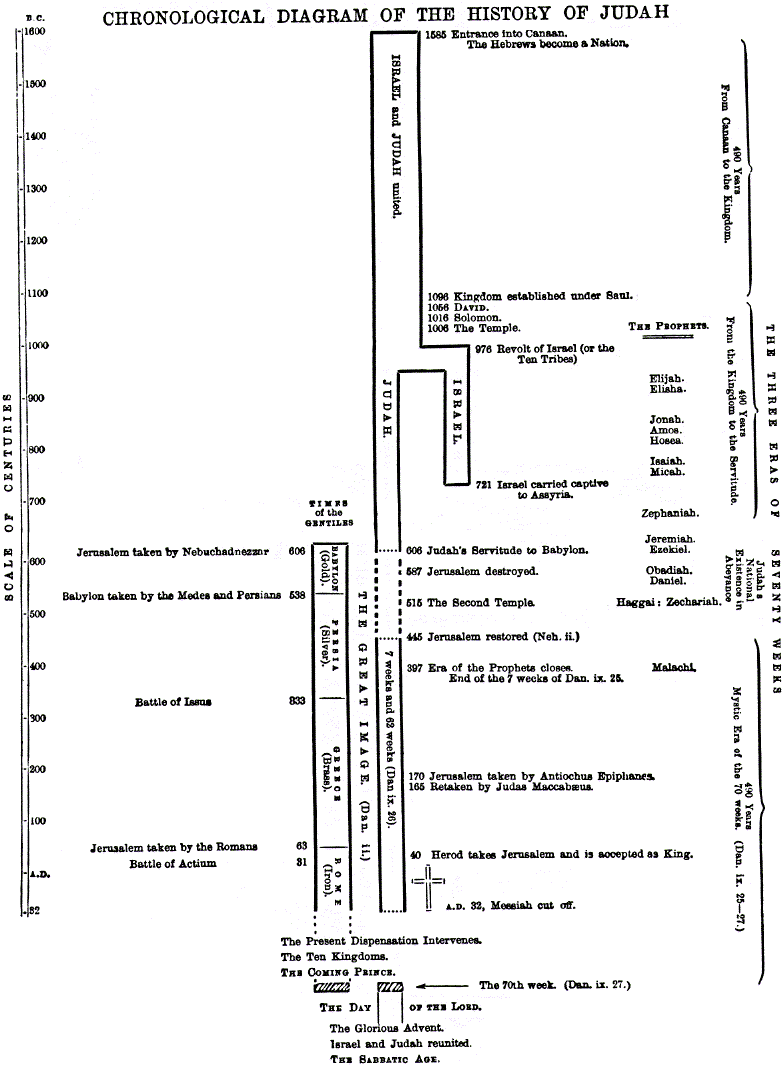
CHRONOLOGICAL DIAGRAM OF THE HISTORY OF
JUDAH (784 x 1068 pixels) ---New Window
APPENDIX 3. Back to
Top
A RETROSPECT AND A REPLY
"TAKE heed that no man deceive you." Such were the first words of our
Lord's reply to the inquiry, "What shall be the sign of Thy coming, and of the
end of the age?" And the warning is needed still. "It is not for you to
know the times or the seasons," was almost His last utterance on earth, before
He was taken up. And if this knowledge was denied to His holy apostles and prophets,
we may be sure it has not been disclosed to us today. Nor can a secret which, as
the Lord declared, "the Father hath put in His own power,"
(Acts 1:7) be discovered by astronomical research or flights of higher mathematics.
But, on the other hand, no thoughtful Christian can ignore the signs and portents
which mark the days we live in. I little thought as I penned the introductory chapter
of this book that the advance of infidelity would be with such terribly rapid strides.
In the few brief years that have since elapsed the growth of skepticism within the
Churches has exceeded even the gloomiest forecast. And side by side with this, again,
the spread of spiritualism and demon-worship has been appalling. Its rotaries are
reckoned by tens of thousands; and in America it has already been systematized into
a religion, with a recognized creed and cult.
But these dark features of our times, striking and solemn though they be, are not
the most significant. While the warned-against apostasy of the last days thus seems
to be drawing near, we are gladdened by signal triumphs of the Cross. It is not merely
that at home and abroad the Gospel is being preached by such multitudes with a freedom
never known before, but that, in a way unprecedented since the days of the Apostles,
the Jews are coming to the faith of Christ. The fact is but little known that during
the last few years more than a quarter of a million copies of the New Testament in
Hebrew have been circulated among the Jews in Eastern Europe, and the result has
been their conversion to Christianity, not by ones and twos, as in the past, but
in large and increasing numbers. Entire communities in some places have, through
reading the word of God, accepted the despised Nazarene as the true Messiah. This
is wholly without parallel since Pentecostal times.
Then again, the return of the Jews to Palestine is one of the strangest facts of
the day. There is scarcely a country in the world that does not offer more attractions
to the settler, be he agriculturist or trader; and yet, since The Coming Prince
was written, more Jews have migrated to the land of their fathers than returned
with Ezra when the decree of Cyrus brought the servitude to a close. But yesterday
the prophecy that Jerusalem should be inhabited "as towns without walls"
seemed to belong to a future far remote. The houses beyond the gates were few in
number, and no one ventured abroad there after nightfall. Today the existence of
a large and growing Jewish town outside the walls is a fact within the knowledge
of every tourist, and year by year the immigration and the building still go on.
If I venture to touch upon the international politics of Europe, it will be but briefly,
in connection with the prophecy of the seventh chapter of Daniel. I have given in
detail my reasons for suggesting that the "historical" interpretation of
that vision does not exhaust its meaning, [1]
and I own to a deepening conviction that every part of it awaits its fulfillment.
There, as elsewhere in the Scriptures, "the great sea" must surely mean
the Mediterranean; and a terrible struggle for supremacy in the Levant appears to
be the burden of the earlier portion of the vision. The nearness of such a struggle
is now being anxiously discussed in every capital in Europe, and nowhere more anxiously
than here at home. Never indeed since the days of Pitt has there been such cause
for national anxiety; and the question of the balance of power in the Mediterranean
has recently gained a prominence and interest greater and more acute than ever before
attached to it.
I will not notice topics of a more doubtful character, but confine myself to these;
nor will I attempt by word-painting to exaggerate their significance. But here we
are face to face with great public facts. On the one hand, there is this spread of
infidelity and demon-worship, preparing the way for the great infidel and devil-inspired
apostasy of the last days; and, on the other hand, there are these spiritual and
national movements among the Jews, wholly without precedent during all the eighteen
centuries which have elapsed since their dispersion. And, finally, the Cabinets of
Europe are watching anxiously for the beginning of a struggle such as prophecy warns
us will ultimately herald the rise of the last great monarch of Christendom. Is all
this to be ignored? Is there not here enough on which to base, I will not say the
belief, but an earnest hope, that the end may be drawing near? If its nearness be
presented as a hope, I cherish and rejoice in it; if it be urged as a dogma, or an
article of faith, I utterly repudiate and condemn it.
As we dwell on these things a double caution will be opportune. These events and
movements are not in themselves the fulfillment of the prophecies, but merely indications
on which to found the hope that the time for their fulfillment is approaching. Any
who searched their Bibles amidst the strange, and startling, and solemn events of
a century ago must surely have concluded that the crisis; was then at hand; and it
may be that once more the tide: which now seems so rapidly advancing may again recede:.
and generations of Christians now unborn may still be: waiting and watching upon
earth. Who will dare to set a limit to the long-suffering of God? and this is His
own explanation of His seeming "slackness." (2 Peter 3:9.)
We need further to be warned against the error into which the Thessalonian Christians
were betrayed. Their conversion was described as a turning from idols to serve the
true God and "to wait for His Son from heaven." And the coming of the Lord
was presented to them as a practical and present hope, to comfort and gladden them
as they mourned their dead. (1 Thessalonians 1:9, 10, and 4:13-18.) But when the
Apostle passed on to speak of "the times and seasons" and "the day
of Jehovah," (1 Thessalonians 5:1-3.) they misunderstood the teaching; and,
supposing that the coming of the Lord was immediately connected with the day of Jehovah,
they concluded that that awful day was breaking. On both points they were wholly
wrong. In the Second Epistle the Apostle wrote, "Now we beseech you, brethren,
in behalf of the coming of our Lord Jesus Christ and our gathering together unto
Him, to the end that ye be not quickly shaken from your mind, nor yet be troubled,
either by spirit, or by word, or by epistle as from us [referring of course to the
First Epistle], as that the day of the Lord is now present." [2]
"The times and seasons" are connected with Israel's hope and the
events which will precede the realization of it. (Acts 1:6, 7.) The Church's hope
is wholly independent of them. And if the Christians of the early days were taught
to "live looking for that blessed hope," how much more may we! Not a line
of prophecy must first be fulfilled; not a single event need intervene. And any system
of interpretation-or of doctrine which clashes with this, and thus falsities the
teaching of the Apostles of our Lord, stands thereby condemned. [3]
Let us then beware lest we fall into the common error of exaggerating the
importance of contemporary movements and events, great and solemn though they be;
and let the Christian take heed lest the contemplation of these things should lead
him to forget his heavenly citizenship and his heavenly hope. The realization of
that hope will but clear the stage for the display of the last great drama of earth's
history as foretold in prophecy.
If the digression may be pardoned, it may be well to amplify this, and explain' my
meaning more fully. That Israel will again be restored to the place of privilege
and blessing upon earth is not a matter of opinion, but of faith; and no one who
accepts the Scriptures as Divine can question it. Here the language of the Hebrew
prophets is unusually explicit. Still more emphatic, by reason of the time when it
was given, is the testimony of the Epistle to the Romans. The very position of that
Epistle in the sacred Canon gives prominence to the fact that the Jew had then been
set aside. The New Testament opens by chronicling the birth of Him who was Son of
Abraham and Son of David, (Matthew 1:1.) the seed to whom the promises were made
and the rightful Heir to the scepter once entrusted to Judah; and the Gospels record
His death at the hands of the favored people. Following the Gospels comes the narrative
of the renewed offer of mercy to that people, and of their rejection of it. "To
the Jew first" is stamped upon every page of the Acts of the Apostles; and it
characterized the transitional Pentecostal dispensation of which that book is the
record. The Pentecostal Church was essentially Jewish. Not only were the Gentiles
in a minority, but their position was one of comparative tutelage, as the record
of the Council of Jerusalem gives proof. (Acts 15. See also chap. 11:19.)
Even the Apostle of the Gentiles, in the whole course of his ministry, brought the
Gospel first to the Jews. "It was necessary that the word of God should
first have been spoken to you," he said to them at Antioch. (Acts 13:46; cf.
17:2, 18:4.) "The salvation of God is sent unto the Gentiles, and they will
hear it," was his final word to them at Rome when they rejected his testimony
and "departed." (Acts 28:29.)
And the next book of the Canon is addressed to believing Gentiles. But in
that very Epistle the Gentiles are warned that "God has not cast away His people."
Through unbelief the branches are broken off, but the root remains, and "God
is able to graft them in again." "And so all Israel shall be saved, as
it is written, There shall come out of Sion the Deliverer, and He shall turn away
ungodliness from Jacob." [4]
. Judgment will in that day mingle with mercy, for He "whose fan is in
His hand" will then gather His wheat into the garner, but burn up the chaff
with unquenchable fire. The true remnant of the covenant people will become the "all
Israel" of days of future blessedness.
That remnant was typified by the "men of Galilee" who stood around Him
on the Mount of Olives as "He was taken up, and a cloud received Him out of
their sight." And as with straining eyes they watched Him, two angel messengers
appeared to renew the promise which God had given centuries before through Zechariah
the prophet:
A glance at the prophecy will suffice to show that the event it speaks of is wholly
different from the Coming of the First Epistle to the Thessalonians. It is the same
Lord Jesus, truly, who is coming for His Church of this dispensation and coming to
His earthly people gathered in Jerusalem in a dispensation to follow; but otherwise
these "Comings" have absolutely nothing in common. The later manifestation
— His return to the Mount of Olives — is an event as definitely localized as was
His ascension from that same Mount of Olives; and its purpose is declared to be to
bring deliverance to His people on earth in the hour of their supreme peril. Tim
earlier Coming will have no relation to locality at all. All the wide world over,
wherever His dead have been laid to rest, "the trump of God" shall call
them back to life, in "spiritual bodies" like His own; and wherever living
"saints" are found, they "will be changed, in a moment, in the twinkling
of an eye," and all shall be caught up together to meet Him in the air. While
the profane skeptic ridicules all this, and the religious skeptic ignores it, the
believer remembers that his Lord was thus caught up to heaven; and as he ponders
the promise, his wonder leads to worship, not to unbelief.
And this event, which is the Church's proper hope, is as independent of the chronology,
as it is of the geography, of earth. It is with the fulfillment of Irsrael's hope
that the "times and seasons" have to do, and the signs and portents that
belong to them. The Lord's public manifestation to the world is a further event distinct
from both. Our Jehovah-God will come with all His holy ones; (Zechariah 14:5.) the
Lord Jesus will be revealed in flaming fire, taking vengeance. [5] What interval of time will separate these successive stages
of "the Second Advent," we cannot tell. It is a secret not revealed. All
that concerns us is, "rightly dividing the word of truth," to mark that
they are in all respects distinct. [6]
I use the expression "Second Advent" merely as a concession to popular
theology, for it has no Scriptural warrant. It would be better to discard it altogether,
for it is the cause of much confusion of thought and not a little positive error.
It is a purely theological term, and it belongs properly to the great and final Coming
to judge the world. But while many refuse to believe that there will be any revelation
of Christ to His people upon earth until the epoch of that great crisis, the more
careful student of Scripture finds there the clearest proof that there will be a
"Coming" before the era popularly called "the millennium."
Here again there are those who, while clearly recognizing a "pre-millennial
advent," have failed to notice the difference, so plainly marked in Scripture,
between the Coming for the Church of the present dispensation, the Coming to the
earthly people in Jerusalem, and the Coming to destroy the Lawless One and to set
up the kingdom.
But, it may be urged, Is not the expression justified by the closing verse of the
ninth chapter of Hebrews? It is only the superficial reader of the passage, I reply,
who can use it thus. "Unto them that look for Him shall He appear the second
time," our Authorized Version renders it. And the words are taken as though
they were equivalent to "His second appearing," "the Appearing"
being a recognized synonym for "the Coming." But this is merely: trading
on the language of our English version. The word actually employed is wholly different.
It is a general word, and it is the very word used with reference to His manifestation
to His disciples after the Resurrection. [7]
And further, the definite article must be omitted:
The statement is not prophetic, but doctrinal; and the doctrine in question is
not the Advent, but the priesthood. It is not the prediction of an event to be realized
by those who shall be alive on earth at the time of the end, but the declaration
of a truth and a fact to be realized by every believer, no matter in what dispensation
his sojourn upon earth may fall.
The passage therefore cannot be appealed to in support of the dogma that never again
but once will Christ appear to His people upon earth. And as the expression
"Second Advent" is so intimately connected with that dogma, it would be
well that all intelligent students of Scripture should unite in discarding it. The
Coming of Christ is the hope of His people in every age.
------------------------------
The only adverse criticism I have seen of The Coming Prince has appeared in
later editions of The Approaching End of the Age. Feelings of esteem and friendship
for the author influenced my notice of that work, but no considerations of this kind
have restrained his pen in replying to my strictures; and the fact that a writer
so able and so bitterly hostile has not ventured to question in a single point
the main conclusions here established is a signal proof that they are irrefutable.
Dr. Grattan Guinness complains that I have made no attempt to "reply" to
his book. My only reference to it has been made incidentally in an appendix note;
and in so far as it deals with the "primary and partial realization of the prophecies"
I have taken the liberty of praising it. Why then should I "reply "to a
treatise in respect of that in it which I value and adopt? These pages give proof
how thoroughly I accept a historical interpretation of prophecy; [8] and if any one demands why then I have not given it greater
prominence, I recall St. James's answer when the Apostles were accused of neglecting
in their teaching the writings of Moses. "Moses," he declared, "hath
in every city them that teach him. "What was needed, therefore, if the equilibrium
of doctrine was to be maintained, was that they should teach grace. On
similar grounds the task I here set myself was to deal with the fulfillment of
the prophecies. But I have no controversy with those who use their every talent in
unfolding the "historical" interpretation of them. My quarrel is only with
men who practically deny the Divine authorship of the sacred word, by asserting that
their apprehension of it is the limit of its scope, and exhausts its meaning. And
The Coming Prince is a crushing reply to the system which dares to write".
Fulfilled" across the prophetic page. "The real question at issue here,"
I again repeat, "is the character and value of the Bible." Dr. Guinness
asserts that the apocalyptic visions have been fulfilled in the events of
the Christian era. I hold him to that issue, and I test it by a reference to the
vision of the sixth chapter. Has this been fulfilled, as in fact he dares to assert
it has? The question is vital, for if this vision still awaits fulfillment, so also
do all the prophecies which follow it. Let the reader decide this question for himself,
after studying the closing verses of the chapter, ending with the words, "For
THE GREAT DAY OF HIS WRATH IS COME, and who shall be able to stand?"
The old Hebrew prophets were inspired of God to describe the terrors of "the
great day of His wrath," and the Holy Spirit has here reproduced their very
words. (Cf. Isaiah 13:9, 10, and Joel 2:31, 3:15; see also Zephaniah
1:14, 15.) The Bible contains no warnings more awful in their solemnity and definiteness.
But just as the lawyer writes "Spent" across a statute of which the purpose
has been satisfied, so these men would teach us to write "Fulfilled" across
the sacred page. They tell us, forsooth, that the vision meant nothing more than
to predict the rout of pagan hordes by Constantine [9] To speak thus is to come perilously near the warned-against
sin of those who "take away from the words of the book of this prophecy."
But when our thoughts turn to these teachers themselves we are restrained by remembering
their piety and zeal, for "their praise is in all the Churches." Let us
then banish from our minds all thoughts of the men, and seize upon the system
which they advocate and support. No appeal to honored names should here be listened
to. Names as honorable, and a hundred times more numerous, can be cited in defense
of some of the crassest errors which corrupt the faith of Christendom. What then,
I ask, shall be our judgment on a system of interpretation which thus blasphemes
the God of truth by representing the most awful warnings of Scripture as wild exaggeration
of a sort but little removed from falsehood?
If it be urged that the events of fifteen centuries ago, or of some other epoch in
the Christian dispensation, were within the scope of the prophecy, we can consider
the suggestion on its merits; but when we are told that the prophecy was thus fulfilled,
we can hold no parley with the teaching. It is the merest trifling with Scripture.
And more than this, it clashes with the great charter truth of Christianity. If the
day of wrath has come, the day of grace is past, and the Gospel of grace is no longer
a Divine message to mankind. To suppose that the day of wrath can be an episode in
the dispensation of grace is to betray ignorance of grace and to bring Divine wrath
into contempt. The grace of God in this day of grace surpasses human thought; His
wrath in the day of wrath will be no less Divine. The, breaking of the sixth seal
heralds the dawning of that awful day; the visions of the seventh seal unfold its
unutterable terrors. But, we are told, the pouring out of the vials, the "seven
plagues which are the last, for in them is finished the wrath of God,"
(Revelation 15:1, R.V.) is being now accomplished. The sinner, therefore, may comfort
himself with the knowledge that Divine wrath is but stage thunder, which, in a practical
and busy world, may safely be ignored! [10]
I called attention to Dr. Guinness's statement that "from the then approaching
command to restore and to build again Jerusalem to the coming of Messiah the Prince
was to be seventy weeks"; and I added," This is a typical instance
of the looseness of the historical school in dealing with Scripture." Of this,
and of some other errors which I noticed, the only defense he offers is that "expressions
not strictly correct, yet perfectly legitimate, because evidently elliptical, are
for brevity's sake employed." How brevity is attained by writing "seventy"
instead of "sixty-nine" I cannot conceive. The statement is a sheer perversion
of Scripture, unconsciously made, no doubt, to suit the exigencies of a false system
of interpretation. The prophecy plainly declares the period "unto Messiah the
Prince" to be sixty-nine weeks, leaving the seventieth week to be accounted
for after the specified epoch; but Dr. Guinness's system can give no reasonable
account of the seventieth week, and so, unconsciously, I repeat, he shirks the difficulty
by misreading the passage. Insist on his reading it aright and accounting for the
last seven years of the prophetic period, and his interpretation of the vision at
once stands refuted and exposed.
When the language of Scripture is treated so loosely by this writer, no one need
be surprised if my words fare badly at his hands. He is wholly incapable of
deliberate misrepresentation, and yet his inveterate habit of inaccuracy has led
him to misread The Coming Prince on almost every point on which he refers
to it. [11]
The fact is, he only knows two schools of prophetic interpretation, the Futurist
and his own; and therefore he seems unable even to understand a book which is throughout
a protest against the narrowness of the one and the mingled narrowness and wildness
of the other. But his personal references are unworthy of the writer and of the subject.
I pass on to deal with the only points on which his criticisms are of any general
interest or importance; I mean the predicted division of the Roman earth, and the
relations between Antichrist and the apostate Church.
My statement was: "The division of the Roman earth into ten kingdoms has never
yet taken place. That it has been partitioned is plain matter of history and of fact;
that it has ever been divided into ten is a mere conceit of writers of this school."
"An astonishingly reckless assertion" Dr. Guinness declares this to be;
and yet we have but to turn the page to obtain from his own pen the plainest admission
of its truth. It must be borne in mind, he says, that the ten kingdoms are to be
sought "only in the territory west of Greece." And if we are prepared
to accept this theory, we shall find, after making large allowances as to boundaries,
that in this, which is prophetically the least important moiety of the Roman earth,
"the number of the kingdoms of the European commonwealth has, as a rule,
averaged ten." Mr. Guinness gives a dozen lists — and he tells us he has a hundred
more in reserve — to prove that, with kaleidoscopic instability and vagueness, or,
to quote his words, "amidst increasing and almost countless fluctuations, the
kingdoms of modern Europe have from their birth to the present day always averaged
about ten in number." "Averaged about ten," mark, though the
prophecy specifies ten with a definiteness which becomes absolute by its mention
of an eleventh rising up and subduing three of them. And "modern Europe,"
too! Zeal for the Protestant cause seems to blind these men to the plainest teaching
of Scripture. Jerusalem, and not Rome, is the center of the Divine prophecies and
of God's dealings with His people; and the attempt to explain Daniel's visions upon
a system which ignores Daniel's city and people does violence to the very rudiments
of prophetic teaching. This vaunted canon of interpretation, which reads "modern
Europe" instead of the prophetic earth, is, I repeat, "a mere conceit of
writers of this school." First they minimize and tamper with the language of
prophecy, and then they exaggerate and distort the facts of history to suit their
garbled reading of it. "Can they," Dr. Guinness demands of us, "alter
or add to this tenfold list of the great kingdoms now occupying the sphere of old
Rome? — Italy, Austria, Switzerland, France, Germany, England, Holland, Belgium,
Spain, and Portugal. Ten, and no more! ten, and no less!" I answer, Yes, we
can both alter it and add to it. The list includes territory which was never within
"the sphere of old Rome" at all, and it omits altogether nearly half of
the Roman earth.
This is bad enough, but it is not all. For if we accept his statements, and seek
to interpret the thirteenth chapter of Revelation by them, he at once changes his
ground and protests against our numbering "Protestant nations "among the
ten horns at all. They are "chronologically out of the question," he tells
us. Here is the language of this vision about Antichrist. "And
there was given to him authority over every tribe, and people, and tongue, and nation.
And all that dwell on the earth shall worship him, every one whose name hath not
been written in the book of life." (Revelation 13:7, 8, R.V.) What mean
these most definite and solemn words? Nothing, he tells us, but that "throughout
the Dark Ages," and "prior to the rise of Protestantism," the Roman
Catholic religion should prevail in the western moiety of the Roman earth. This,
he declares, is "the fulfillment of the prediction." He calls this
"explaining" Scripture. Most people would call it explaining it away!
I now come to the last point. "Our critics maintain," Dr. Guinness writes,
"that Babylon runs her career, and is destroyed by the ten horns, who then agree
and give their power to Antichrist, or the Beast. That is, they hold that the reign
of Antichrist follows the destruction of Babylon by the ten horns."
The foundation of this statement must be sought in the author's own lucubrations,
for nothing to account for it will be found in the pages he criticizes; and a similar
remark applies to his references to The Coming Prince in the paragraphs which
follow. I will not allude to them in detail, but in a few sentences dispose of the
position he is seeking to defend.
We have now got to the seventeenth chapter of Revelation. His argument is this. The
eighth head of the Beast must be a dynasty; the Beast carries the Woman; the Woman
is the Church of Rome. Therefore the dynasty symbolized by the eighth head must have
lasted as long as the Church of Rome; and thus the Protestant interpretation is settled
"on a foundation not to be removed."
It is not really worth while pausing to show how gratuitous are some of the assumptions
here implied. Let us, for the sake of argument, accept them all, and what comes of
it? In the first place, Dr. Guinness is hopelessly involved in the transparent fallacy
I warned him against in this volume. The Woman is destroyed by the agency of the
Beast. How then is he going to separate the Pope from the apostate Church of which
he is the head, and which, according to the "Protestant interpretation,"
would cease to be the apostate Church if he were no longer owned as head?
The historicist must here make choice between the Woman and the Beast. They are distinct
throughout the vision, and in direct antagonism at the close. If the Harlot represents
the Church of Rome, his system gives no account whatever of the Beast; it ignores
altogether the foremost figure in the prophecy, and the vaunted "foundation"
of the so-called "Protestant interpretation" vanishes into air. Or if he
takes refuge upon the other horn of the dilemma, and maintains that the Beast symbolizes
the apostate.. Church, the Harlot remains to be accounted for. He, forgets, moreover,
that the Beast appears in Daniel's visions; in relation to Jerusalem and Judah. Suppose,
therefore,. we should admit everything he says, what would it amount to? Merely a
contention that "the springing and germinant accomplishment" of these prophecies
"throughout many' ages" (I quote Lord Bacon's words once more) is fuller,
and clearer than his critics can admit, or the facts of history' will warrant. The
truth still stands out plainly that "the height or fullness of them" belongs
to an age to come:, when Judah shall once more be gathered in the Promised Land,
and the light of prophecy which now rests dimly' upon Rome shall again be focused
on Jerusalem.
The popularity of the historical system lies no doubt in the appeal it makes to the
"Protestant spirit." But surely we can afford to be sensible and fair in
our denunciation of the Church of Rome. Who can fail to perceive the growth of an
antichristian movement that may soon lead [ us to hail the devout Romanist as an
ally? With such, the Bible, neglected though it be, is still held sacred as the inspired
word of God; and our Divine Lord is reverenced and worshipped, albeit the truth of
His Divinity is obscured by error and superstition. I appeal here to the Pope's Encyclical
Letter of the 18th November, 1893, on the study of the Holy Scriptures. The following
is an extract from it:--
"We fervently desire that a greater number of the faithful should undertake
the defense of the holy writings, and attach themselves to it with constancy; and,
above all, we desire that those who have been admitted to Holy Orders by the grace
of God should daily apply themselves more strictly and zealously to read, meditate
upon, and explain the Scriptures. Nothing can be better suited to their state. In
addition to the excellence of such knowledge and the obedience due to the word of
God, another motive impels us to believe that the study of the Scriptures should
be counseled. That motive is the abundance of advantages which follow from it, and
of which we have the guarantee in the words of Holy Writ: 'All Scripture is given
by inspiration of God, and is profitable for doctrine, for reproof, for correction,
for instruction in righteousness, that the man of God may be perfect, thoroughly
furnished unto all good works. It is with this design that God gave man the Scriptures;
the examples of our Lord Jesus Christ and His apostles show it. Jesus Himself was
accustomed to appeal to the holy writings in testimony of His Divine mission."
There is here surely, in some sense at least, the ground for a common faith, which
might, as regards individual Christians, be owned as a bond of brotherhood; but an
impassable gulf divides us from the ever-increasing host of so-called Protestants
who deny the Divinity of Christ and the inspiration of the Scriptures. These have
their true place in the great army of infidelity which will muster at last around
the banner of the Antichrist.
My protest is made, not in defense of the Papacy, but of the Bible. If any one can
point to a single passage of Scripture relating to Antichrist, whether in
the Old Testament or in the New, which can, without whittling it down, and frittering
away the meaning of the words, find its fulfillment in Popery, I will publicly
retract, and confess my error. Take 2 Thessalonians 2:4 as a sample of the rest.
The "man of sin" "opposeth and exalteth himself against all that is
called God or that is worshipped [Greek, that is an object of worship], so that he
sitteth in the temple of God, setting himself forth as God." This means merely,
forsooth, that on certain occasions the Pope's seat in St. Peter's is raised above
the level of the altar on which the "consecrated wafer" lies! Such statements
— I care not what names may be cited in support of them — are an insult to our intelligence
and an outrage upon the word of God. [12]
Then, again, in the ninth verse, the coming of the "Lawless One"
is said to be "according to the working of Satan, with all power and signs and
lying wonders." These words are explained by the vision of the Beast in the
thirteenth chapter of the Revelation, which declares that "the Dragon gave him
his power, and his throne, and great authority." And we have from the lips of
our blessed Lord Himself the warning, that the "great signs and wonders,"
thus to be wrought by Satanic power, shall be such that, "if it were possible,
they shall deceive the very elect." (Matthew 24:24.) In a word, the awful and
mysterious power of Satan will be brought to bear upon Christendom with such terrible
effect, that human intellect will be utterly confounded. Agnosticism and infidelity
will capitulate in presence of overwhelming proof that supernatural agencies are
at work. And if faith itself, divinely given, shall stand the test, it is only because
it is impossible for God to allow His own elect to perish.
When we demand the meaning of all this, we get answer "Popery." But where,
we ask, are the "great signs and wonders" of the Popish system? And, in
reply, we are told of its millinery, and its mummery, and all the well-known artifices
of priestcraft, which constitute its special stock-in-trade. As though there were
anything in these to deceive the elect of God! To take the low ground of mere
Protestantism, it is notorious that here in England none become entangled in the
toils of Rome save such as have already become enervated and corrupted by sacerdotalism
and superstition within the communion they abandon. And it is no less notorious that,
in Roman Catholic countries, the majority of men maintain towards it an attitude
of either benevolent or contemptuous indifference. Remembering, moreover, that the
followers of the Beast are doomed to endless and hopeless destruction, we go on to
inquire whether this is to be the fate of every Roman Catholic. By no means, we are
assured; for, in spite of the evils and errors of the Romish Church, some within
its pale are reckoned among the number of "God's elect."
What conclusion, then, are we to come to? Are we to accept it as a canon of interpretation
that Scripture never means what it says? Are we to hold that its language is so loose
and unreliable as to be practically false? We repudiate the profane suggestion; and,
adopting the only possible alternative, we boldly assert that all these solemn words
still await their fulfillment. In a word, we are shut up to the conclusion that THE
ANTICHRIST IS YET TO COME.
.
CHAPTER 1 INTRODUCTORY on page 1
---New Window
CHAPTERS 2-3 on page 2
---New Window
CHAPTERS 4-6 on page 3
---New Window
CHAPTERS 7-9 on page 4
---New Window
CHAPTERS 10-12 on page 5
---New Window
CHAPTERS 13-15 on page 6
---New Window
PREFACES on page 7
---New Window
APPENDICES on page 8 (this page)
.
.
.
For more about the author, read:
Sir
Robert Anderson and the Seventy Weeks of Daniel ---New Window

Section Index for Voices
of Philadelphia

.
Homepage  Holy Bible
.Jehovah Jesus
Timeline .Prophecy Philadelphia Fellowship Promises Stories Poetry Links
Holy Bible
.Jehovah Jesus
Timeline .Prophecy Philadelphia Fellowship Promises Stories Poetry Links

Purpose ||.What's New
|| Tribulation Topics || Download Page || Today's Entry
Topical Links:
Salvation || Catholicism || Sound Doctrine || Prayer
Privacy Policy
.